I just saw a post that said being needed and being loved can feel very similar, but they are not the same.
I completely agree. Over the years I’ve discovered that a lot of things feel like love that aren’t actually love.
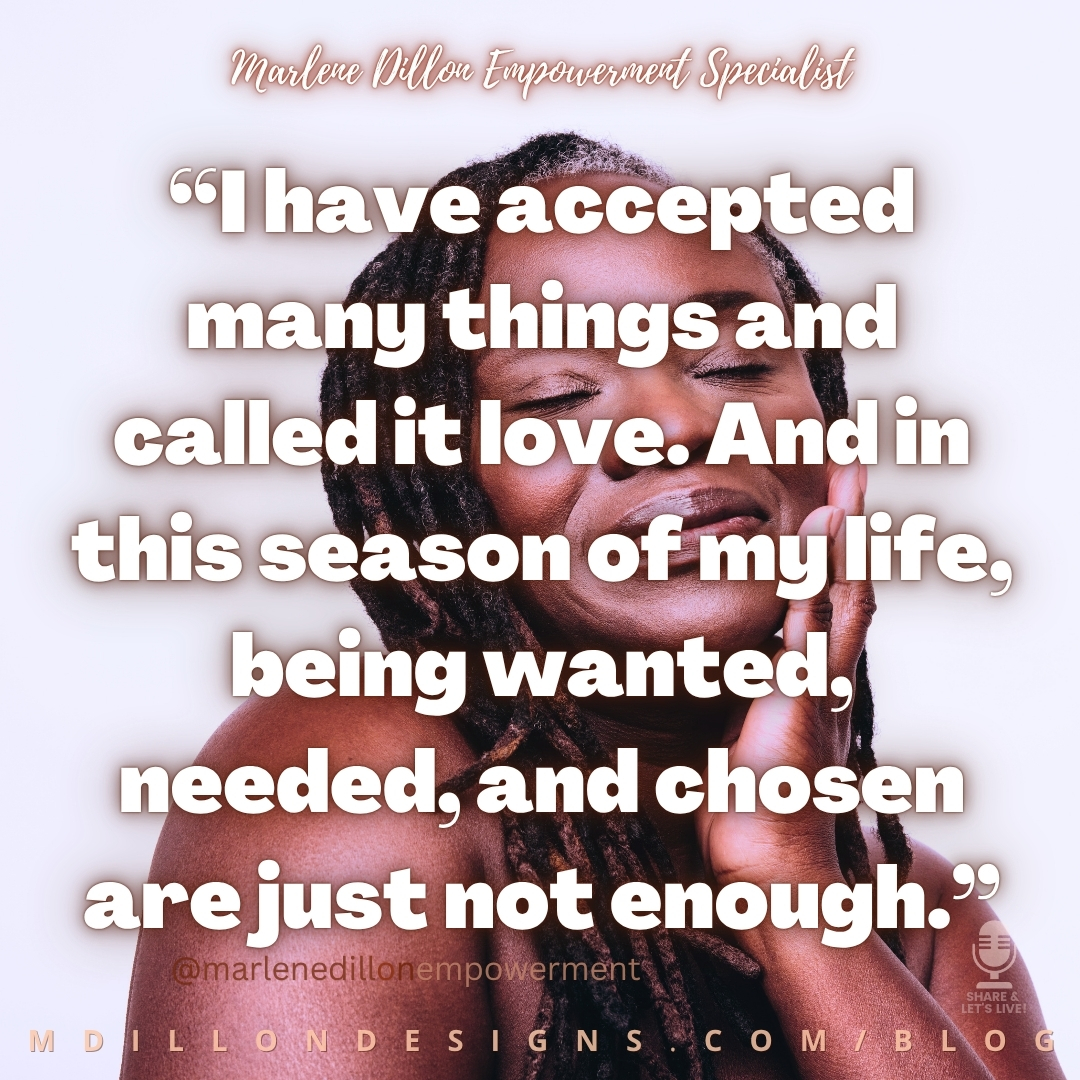
In the past, feeling needed felt like love. If I was serving a purpose, I would get the smiles, and the connection through their appreciation that made me feel good, that made me feel loved.
Feeling “wanted” was a big one for me. good enough for me. Whether it was the impact of teen movies and after school specials, or just being the friend who the guys never chose, someone focusing their attention on me made me feel special, and that special feeling was love to me.
Let me break it down a little further (farther? 🤔 I never know the difference 😆)….
And I’m not embarrassed to say that, because I understand the psychology around it.
I’m my family, I was the youngest. So I grew up in an environment where everyone wanted nothing to do with me because I was “too little.” They couldn’t watch what they wanted to watch, they couldn’t say what they wanted to say, they couldn’t be free to be around their friends, because I would have to tag along. And there was no subtlety in letting me know that I was not welcomed.
And with that being my daily in the house experience growing up, it impacted my core beliefs about myself and my right to be present, and how other people would view me. I didn’t hold much of an expectation that people would want me around because in a large family nobody really did. (Okay one exception was my dad. But he was at work from early in the morning ’til evening so I would have to wait until he got home before I could be around anybody who actually enjoyed/ didn’t mind my presence).
At school I didn’t really fit in because my parents were so strict. I didn’t get to go out and play so I didn’t know how to jump double dutch. I didn’t know any of the hand games or get to watch the shows that other kids got to watch. And I was terribly quiet because I was afraid of getting in trouble. So I didn’t exactly fit at school.
So fast forward to being in junior high and high school, when people are starting to couple up. My personality was more developed, and I had friends, but I was also super religious. So even though I was terribly lonely, and wanted a boyfriend like everybody else, I wasn’t exactly the peak choice for guys.
That thirst for attention made even the slightest gesture of interest from a guy feel like a full-on declaration of love. I wasn’t used to be chosen. I was used to being the “wing girl” who talked to a guy’s friend, so he could talk to mine.
The guys always wanted to talk to my friends, never to me. So when my gorgeous, chocolate, 6’3″, basketball playing first boyfriend initially approached me, I didn’t even believe him at first. I was with the same friends who were always chosen, but he chose ME.
And, of course, I was all in. Whatever he wanted (short of that) I was giving in. I didn’t want to lose him.
He was the first person to tell me, “I love you.” My parents were old school and they really weren’t doing that kind of affectionate stuff. I can’t say that they never said “I love you,” but it wasn’t voluntary. It was because the minister on New Year’s Eve at watch night service said, “Go around and hug your neighbor and tell them, ‘I love you with the love of the Lord.'” I never really heard it outside of that kind of context.
So when my first boyfriend said those words, it meant everything to me. He could have asked me to paint the sky and I would have found a way to do it. Not losing his love meant so much to me that I ignored how he made me feel. I ignored the way I was constantly compromising my values to keep him. I ignored the things he did that were inappropriate, manipulative, and inexcusable. I ignored that we broke up pretty much every other week, because I wouldn’t “put out.” And I’d cry and beg him to come back because I “needed” him to love me. In my mind, he was the only one who did. So I cry and my friends would call and cuss him out and and we’d get back together. And I’d be happy until the next time.
I thought I would save this for the memoir. 🤣 But who knows if I’ll ever get to write that. Thanks ADHD.
Anywho, we did that on and off thing for years. And eventually we ended things. I met and fell in love with others over varying levels of attention, affection, attraction, and feeling grateful to be chosen. I stayed when they did not treat me well, caused me to question my worth, expected me to give more than I was receiving, and put me on pause to entertain women from their past. I was always understanding and let them do and be as they wanted. I was always accommodating, never suffocating, or jealous. I put up with whatever because they chose me, when they could have chosen anybody.
Simply being chosen, felt like they had given me the world. Giving me any of their time, their attention, wanting to spend time with me, smiling when I enter the room. When a person is starved of affection, even crumbs feel like a meal. I felt fed when I was actually starving.
I finally felt like someone cared about me. Each time. Because in between relationships— except when I chose to take a break intentionally in college and again in adulthood—I just felt alone and sad and unchosen. I felt like I was defective, like something was wrong with me because I didn’t have a person who wanted to be with me….
Now, as an adult who has done sooo much inner healing work, I realize that so much of how I viewed myself came from various sources. My home and school environment, for sure. AND a huge influence came from societal programming through television, movies, Disney stories, and religious culture and teachings. I was highly susceptible, especially given I already had that “I don’t belong,” “unloved,” “unwanted” void.
The message that happily ever after—and my purpose as a woman—comes from being coupled has been everywhere since childhood. Standards weren’t really taught, because being chosen was the only goal. It was all about making myself “choosable.” A man was the prize. So I didn’t demand anything of them. I was happy to take any level of attention they’d offer. Being wanted was awesome. Being chosen was sufficient. And being needed felt like a gift.
It’s crazy how far we can go into life without learning about self-love. I was never taught to observe how I’m treated to see if someone’s actions match their words. If they said they loved me that’s all I needed to know. I’d completely ignore how I felt and what I observed. “It was all in my mind. He said we’re fine.”
But now I’m grown. And I’ve been single long enough to fall in love with myself. I know what love feels like and I know the absence of it. I have evaluated my past relationships and learned the lessons. I have taken the time to observe what I ignored. I looked at each situation plainly, without the love colored glasses. I allowed myself to see things clearly.
And the great thing is that I didn’t just learn to see them differently. I learned to see myself differently. I started to recognize my value. I started to count my assets instead of my shortcomings. I had put up with so much, because I felt they were doing me a favor by being with me. I didn’t see my good.
All my life I have been criticized for what I didn’t do, what I didn’t have, and who I wasn’t. So in relationships, I saw them as putting up with me, because that’s how my parent treated me and the others. I saw how I was an inconvenience or a burden, never a blessing. I overdid my role to compensate for the loss I felt they were sustaining by being with me, instead of someone else.
It’s so hard to even think that I used to feel this way, but I did. That lifetime of having my flaws pointed out and my assets discredited shifted from external criticism to internal. I was so critical of myself. I only saw what I didn’t “bring to the table.”
Then one day, things shifted.
I guess I have my fake ass business “partner” to thank for that. When they took advantage of me and I began to vent to my friend about how hurt I was because they knew I had nothing. I began to ask why they would do this to me. And something happened.
I started to say things like, “Why would they choose me? I have nothing to offer. I mean, I do have an established publishing company, but so what?” Then I thought some more and I said, “Well, I mean I do have a couple published books.” Then I thought some more and said, “Well, I have a fully written program for adolescent girls… annnd… I have run my program in schools.” “Annnd… I guess I do have an online store full of products I designed….. annddd I was chosen as a Women’s History Month speaker for the Chicago Public Libraries… annnnnd…..”
And before I knew it, I had gone from feeling like sh*t to saying, “Wait, I’m the sh*t!” Before that moment, I did not see myself. All I saw was my bank balance. All I saw was my student loan debt. All I saw was that I live in my parents’ basement. I saw that my “husband” left and I was a single mom. I saw what I couldn’t afford, what I couldn’t do, where I couldn’t go…
All I saw was my shortcomings. I never took time to list all of my good stuff. I didn’t see myself through the lens of my assets, just my liabilities. And I allowed partners to come into my life who saw value in me, but I didn’t see it. I felt I was winning because they chose me, when they were winning because I had no idea I was the prize.
But guess what. I am now beginning to see my value. I am beginning to reestablish my standards. I am releasing the not enough feeling to pay more attention to what is good about me. I am realizing all I have to offer and it’s raising my self-worth. I am seeing that I actually bring plenty to the table. I’m clear that just being coupled is not enough. Being chosen doesn’t mean a thing. Being wanted and needed doesn’t mean I’m loved. And being truly loved in an obvious and palpable way that aligns with how I receive love is non-negotioable.
I’m raising my awareness of my awesomeness and raising my standards, and you deserve to do the same. Start counting your good qualities and remember all that makes you awesome. You deserve love that feels like love to you. And so do I.
Blessings,
Marlene Dillon Empowerment Specialist

