I get why you’re frustrated. Teens (and tweens) can be moody, distant, irresponsible, and even rude at times. Some of that is hormonal and a lot of it is internal. They can be a lot. And that can be hard on us parents. Let me try to help.
We already know your side. (Big hugs because it can be ROUGH.) And I want to help you understand their side, so you can navigate this stage with more grace and understanding.
Please try not to be offended. I’m here to help, not judge. I had to learn this stuff to develop a better relationship with my teen daughter. And our relationship is awesome.
From parents to teachers, the issue I always hear is that the kids don’t want to talk (when they’re expected to) and that they’ve got attitude problems. But from my observation, parents and educators typically (unintentionally) create a combative atmosphere. Then, when they decide to try and have calm convos, they wonder why teens/tweens don’t want to talk to them. Honestly, I wouldn’t want to talk to you either.
One major shift is accepting this truth. Most of the times, they aren’t even thinking about you. What you interpret as an attitude typically has nothing to do with you. They’re dealing with social stuff, future fears, school pressure.
So when you come interrupting their few minutes/hours of peace, pushing them to talk about their day that they are happy is over, angry about what they did/didn’t do, fussing about chores and what-have-you, it’s irritating. So when you make it personal (“I’m trying to talk to you and you’ve always got an attitude”), it’s frustrating.
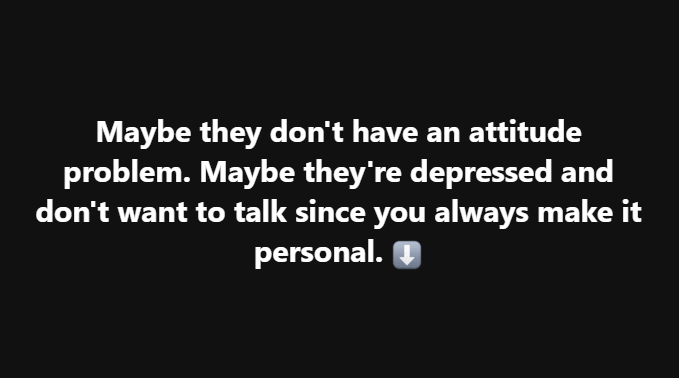
What if they don’t have an attitude? What if they’re just having a bad day, week, month, semester, school year? What if they’re not being rude, they’re sad, lonely, overwhelmed, feeling left out, unattractive, or disappointed in themselves? What if they’re not blowing off school, but are trying really hard to understand, but can’t and they’re dealing with feelings of inadequacy? What if they have no real friends? What if they’re afraid because college and adulthood are around the corner and it’s all happening too fast? What if it’s not about you?
Most of the time when teens are in their room, not wanting to talk, it’s more about what’s going on within them, and the whole life they have outside of you (at school, with their peers, at work if they’re at that age). Their room is their oasis from all the noise they have to navigate in a day. It’s their rest place from all the tough stuff they deal with. And, yes, they have tough stuff to deal with.
Important sidebar:
Challenges don’t start in adulthood. At EVERY stage of development there are challenges and growth opportunities that are uncomfortable. Just because those challenges are small to us doesn’t make them small to them. A baby learning to crawl is not a small task. That’s a challenging task for that stage of development. Learning to walk, being potty trained, being away from parents at daycare/school, learning to hold a pencil and write, learning multiplication, writing essays, navigating peer groups, making friends, dealing with: loneliness, mean kids, mean teachers, etc. and so much more are all valid significant challenges for their stage of development.
Adults can be so self-centered and insensitive as we forget what it was like for us at that age and what it felt like to have those challenges. We lack empathy. We look at everything through the lens of our current age and obstacles. But it doesn’t work that way. When we were their age things that are silly to us now were life and death. We didn’t know how we’d survive embarrassment, isolation, etc. Some of us still hate people from high school, still remember life-shifting moments there. It was significant for us. And they’ve got stuff that’s significant for them, too.
We can’t compare our current challenges to theirs. We’re at a different stage, with our own challenges. And so are they. So let’s stop making it about us, and get curious and compassionate about where THEY are so we can rebuild our relationships through understanding and love.
Okay, let’s get back to it…
After a long day of work, do you want somebody bothering you with more stuff to do? Or do you want to enjoy your time away from work? They are in school nearly 8 hours. And for a lot of them it’s not fun. School is work for them. Navigating social standing and friendships and attraction and connections is work for them. Fitting in and finding friends who accept them is work for them. Navigating toxic ass narcissistic educators and bullies, that’s work for them.
When they get home, they want the freedom to retreat from work. They want silence (from work requests) and respite (whether relaxation, playing, laughing, talking to friends, watching a show, scrolling, sleeping, etc.). The expectation they should be jumping for joy when you say take out the trash, or clean your room, after a full day of work is just insensitive, uncompassionate, and honestly not rooted in love.
And I’m not saying they shouldn’t have chores or be responsible for cleaning up after themselves. AND it’s important to note that symptoms of depression and burnout often look very similar to laziness and a lack of care. So despite your frustration, getting angry and yelling about it might not be the most effective approach.
It’s still possible to get what you want (the trash taken out or the room cleaned), without the argument or nagging. But it starts with changing YOUR tone, and fixing YOUR face, before expecting them to do so.
Putting love in front of all your interactions is key. As obvious as their intentions may be, create a new habit to assume the best not the worst. Instead of being certain they blow off chores because they don’t respect you, or that they’re just nasty and don’t care about being a supportive member of the family, assume the best. Think “What if they do really care about me/us, but something else is going on? What if this is my opportunity to either get closer to them, or push them away?” “What if they are depressed and my words in this moment can show them they are loved, or push them toward a bad decision?” Maybe that’s scary, but I honestly believe most teens (post-pandemic) are right on the verge of depression, or already in it. We have to be mature in how we engage with them. A lot of them are on the edge. So let’s approach them from a place of love. For example…
Notice the difference…
- “You’re always on your phone/that game every time I come in here. Your room is a mess. It’s clear you don’t care. You don’t respect me and you don’t respect yourself. Get this room cleaned up, now!”
- “Hey. You been okay? I noticed your room and you’ve been kinda distant. I know school can be a lot and maybe you’ve got things going on that I don’t know about. I’m here if you ever need to talk. Oh, and I put some extra garbage bags and cleaning supplies outside your door so you can get your room cleaned up. Sometimes being in a clean space can help. Love you.”
Which teen is likely to start cleaning up? Which one is likely to become more distant?
When they hit the teen years, our interactions become more like boss and employee. Nobody wants to work for a boss that’s inconsiderate and yelling all the time, or one that clearly has no idea who we really are. No one wants to tell their mean boss about that their social life. And so on. If you want a good relationship with your teen/tween, you’ve gotta act more like that one supervisor you actually liked.
Sometimes we say and think things about our children that hurts their feelings. When we come at our kids with so much certainty about their negative motives and intentions, rather than be curious, and assume the best, we erode the foundation of our relationship. Our mistrust and hurtful assumptions cause them to distance themselves from us.
We can shift our relationship with our teen by remembering that every stage has its challenges. We can choose to catch ourselves and pivot away from assuming their behavior is about us (or due to whatever we normally expect is the reason). We can remember that their behavior is likely related to a challenge they are dealing with at this developmental stage. And by doing so we can approach them with love and empathy and even a healthy curiosity.
When we lead with love, remember they are dealing with their own challenges, and assume the best we create opportunities to have better relationships with our teens. It’s not on them. It starts with us.
Blesssings!
Marlene Dillon Empowerment Specialist
The advice above is free. And it would be a disservice to you (and me) to not tell you about my ridiculously low priced course for parents. Check this out.
Imagine if there was a course to teach you how to communicate with your child.
Healing Our Families: Healing the Parent-Child Relationship is an online course for parents that teaches you how to improve communication with your child!
Press play below to learn all about my course! I answer all the common FAQs
Heard enough? Enroll, today!
Still got questions? You can actually preview a lesson or two from my course! Find out how here.
Want to purchase this course for someone else as gift? Learn how here.
Want to learn more about me and all I offer? Tap here.
Just want a shortcut to quick links to all my offering. Tap here.

