I believe it was last Mother’s Day when I first shared this. It’s still a very vulnerable, and honestly uncomfortable, thing to share. I’ve just reached a point in my life where my purpose matters more than keeping up appearances. So here’s my story….

Just an fyi… This is not about bashing mothers. This post is about validating the experiences of those who find aspects (or the entirety) of Mother’s Day challenging. Although many people have a beautiful relationship—where there are occasional differences regarding specific subjects—some people’s relationships with their mothers were/are primarily combative, negative, hurtful, abusive, toxic, and/or otherwise unhealthy. If that’s not an experience you can relate to, this post will be informative. If this is your experience, then I hope you find this blog post, and podcast, are affirming and supportive.
It took a lot of courage to write this, after the many years of having people invalidate my experience, but today something shifted in me, and I realized this post is long overdue. So here it is…
Another year of the same sh*t, the dreaded Mother’s Day card shopping experience. For people who love their mothers, and were blessed with a beautiful relationship, and nurturing experience, it may seem the card aisles have a plethora of perfect options. However, to a person whose mother has treated them as a chore, inconvenience, or an enemy, searching for the perfect mother’s day card is a dreaded emotional reminder of what you don’t have, what you didn’t experience, and what having a mother is actually supposed to look like.
I’m not new to the excruciating task that is the annual search for a card. For me, it’s never a planned shopping trip. Every year around this time, I’m in a store and have the same moment of awareness. It goes something like, “F*ck. There’s the Mother’s Day cards display.” Sigh. “Let me just bear down today and get this sh*t over with.”
Aaand today was that day. I was had just wrapped up my shopping at Walmart, and as I was left the travel-sized toiletries display, I walked by the dreaded Mother’s Day cards display. I started to keep walking, but just as I’ve done every year since I was old enough to buy my own cards, I sighed, took that step back to the display, and decided to just get it over with.
No matter how many times I’ve done this… (And… wow… I’m just now realizing I’ve been doing this every year for at least the last 30….) it’s no less mentally and emotionally draining.
Searching through seemingly endless rows of cards is such a multilayered, emotional experience, as I discard them one by one, when I read that one line that invalidates the whole damn card. There’s the annoyance of, “F*ck! How many more of these f*cking cards do I have to read to actually find one that applies?” There’s sadness from not being able to relate to any of the cards and the loneliness of realizing, “Damn, numerous people likely this way about their mom.” Then, I reach the point of frustration and being ready to give up. “F*ck. I’ve gone through every card except two in this whole store! F*ck it. She’s just not getting one.” Then there’s the bargaining, “You know what? I’m just gonna grab one that isn’t obviously inaccurate. Who cares if it doesn’t apply? She’ll be happy.” Then that’s countered with the authenticity police in my mind, that’s like, “The hell you will. Put that sh*t back. Can you imagine hearing her proudly reading that sh*t over the phone?”
And it’s right about then that I get a second wind, say a quick prayer, and prepare to go through the last two. I hold my breath as the cover seems simple and generic enough, and then exhale when the words inside simply, say, “Wishing you a beautiful day.” Sold!
If this isn’t your experience, you may be thinking, “Geez. Why is this such a big deal?” Well, imagine that someone has treated you like their worst mistake for most of your life, AND despite that, you still love them (because we’re wired to love our parents unconditionally). So every year, you feel obligated to do something to honor their title, in part because you know that if you don’t, they’ll add that to the list of things they hold against you. So you attempt to do the bare minimum of meaningful gestures and find a nice card they can feel good about. You go combing through the Mother’s Day cards only to find that each card for the next 40 to 100 cards says:
– “I feel so blessed to have a mother like you.”
– “Mom, thank you for listening, understanding, and being someone I can count on.”
– “I could never thank you enough for all the love you’ve shown me….”
– “To a wonderful woman who’s always made me feel so loved…” and so on.
Card after card is complete trash, because you can’t relate to any of it. And when you find a card with the perfect simple cover, you open it and it’s two pages of loving poetry in honor of the kindest, most loving woman to ever grace the earth. All you want is to quickly find an effing card so you can appease her and move on with your life. Instead you could be in that card aisle for twenty minutes and not find ONE card that is truthful.
And I’ve gone through that every year. And, today, I realized it’s oddly validating.
I cannot count how many times over the years I have told people I don’t have the closest relationship with my mom and they’ve said something to invalidate my experience. “Oh, you know mothers and daughters….” Or “well, at least you’ve still got your mom. Mine passed away, and I wish I could talk to her one last time. Cherish the moments you have.” Or when I’ve mentioned something hurtful she’s done, or said, they say, “Oh, my mom gets on me about stuff like that, too. That’s just how moms are.” And for a second, I start to feel bad, like, “Maybe I’m just making more of this than it is.” I see of similarities in the mother-daughter dynamics in movies, and on tv, and start to wonder if I’m making a big deal out of nothing. I mean it’s rare that anyone who has witnessed our relationship has ever spoken up on my behalf. So maybe I’m just being too sensitive.
Then Mother’s Day comes, and I stand there in that aisle discarding card after card, and I realize that my experience is not the same. I’m not being too sensitive. That person who said, “Oh my mom says things sometimes that hurt my feelings,” can easily find a card in this aisle. Most people don’t have to go through 100 Mother’s Day cards to find one that says so little that it can’t possibly tell a lie about their relationship. Today, I found validation for my experience. As I realized the only card that I could find was one labeled as “For Anybody.” It was so vague, while still celebratory, that it was perfect.
And that’s why I’m writing this….
I wrote this is for all the ones who have a bittersweet relationship with Mother’s Day. This is for the ones who eyeroll when people post about how “a mother’s love is like no other.” This is for the one’s who stand in that card aisle, year after year, discarding card after card because it doesn’t apply to you.
I see you. I feel for you. I am you.
Honestly, these are words I would never say, because no one is supposed to know. But today, I decided that the work I do is too important for me to withhold my words to protect someone’s image. It is my hope that these words bring comfort to you and let you know your experience is valid.
It’s tough standing in that card aisle, searching for the perfect card to lovingly describe a person that has brought you so much pain. It makes sense if you feel sad around this time of year. It makes sense if sometimes miss your mom, because you recognized that the relationship will always be toxic, so you loved yourself enough to stop engaging. You’re holding boundaries, but you still miss the nice parts of her. It hurts, because you still love her, and all you’ve ever wanted is for her to love you back, but you know that if you reconnect, eventually she’s gonna hurt you again.
I wrote this for you, because no one around you can relate to your experience, and I want you to know you’re not alone. Some of us were dealt that hand and we didn’t get the loving one or the emotionally safe one or the warm and fuzzy one. I want you to know that despite your experience, you are lovable, that her treatment of you is not what you deserved. You are worthy of love that feels like love. And I’m sorry.
Today, I’m sending you love and letting you know you have a right to feel as you do. You don’t have to earn love. You deserve it simply because of who you are—simply because you exist. My hope and my wish for you is that you will give yourself the love you wish you received. And I wish for you to also receive it from someone who has the capacity to give you the love you deserve. I hope that you will find healing and be able to release the need for what she didn’t have the capacity to give. And I want you to know that although your particular experience is unique, you are not alone.
Below, I are two books that were particularly helpful, eye-opening, and healing for me. I’m not affiliated with them at all. I just want to share with you what helped me on my healing journey in case they may be of help to you.
- “Daughter Detox: Recovering from An Unloving Mother and Reclaiming Your Life,” by Peg Streep
- “Will I Ever Be Good Enough?: Healing the Daughters of Narcissistic Mothers,” by Karyl McBride
Thank you for reading! Be gentle with yourself. Sending you much love.
If you read this and don’t share this experience, I hope it will help you better understand and empathize with those who do. So many people have occasional disagreements with their moms and assume that all mother-offspring relationships look relatively the same. That’s not true. Some people wouldn’t treat their worst enemies the way they were treated by their mothers. So when people say things like, “Well, that’s still your mom,” or “you should be happy you have your mom,” it can be terribly hurtful and shaming. And that, honestly, just adds another layer on top of the hurt we’ve already experienced, and probably still live with. So thank you for reading and listening. I hope you found this enlightening.
Blessings,
Marlene Dillon Empowerment Specialist
An update just for you…
When I first posted this blog and the podcast, a seed was planted in me. That frustration that I experienced year after year revealed an opportunity.
Often we see a problem and just complain about it. When I have the same issue repeatedly, I start to think about solutions….
I wrote this blog and recorded the podcast because I believed that I can’t possibly be the only one who deals with this. One day, some months back, I shared my idea for a solution with a dear friend. In that convo, I came to realize that she had the same kind of relationship with her mom. I would’ve never known.
There are so many of us suffering in silence… going through this same painful card shopping experience every year.
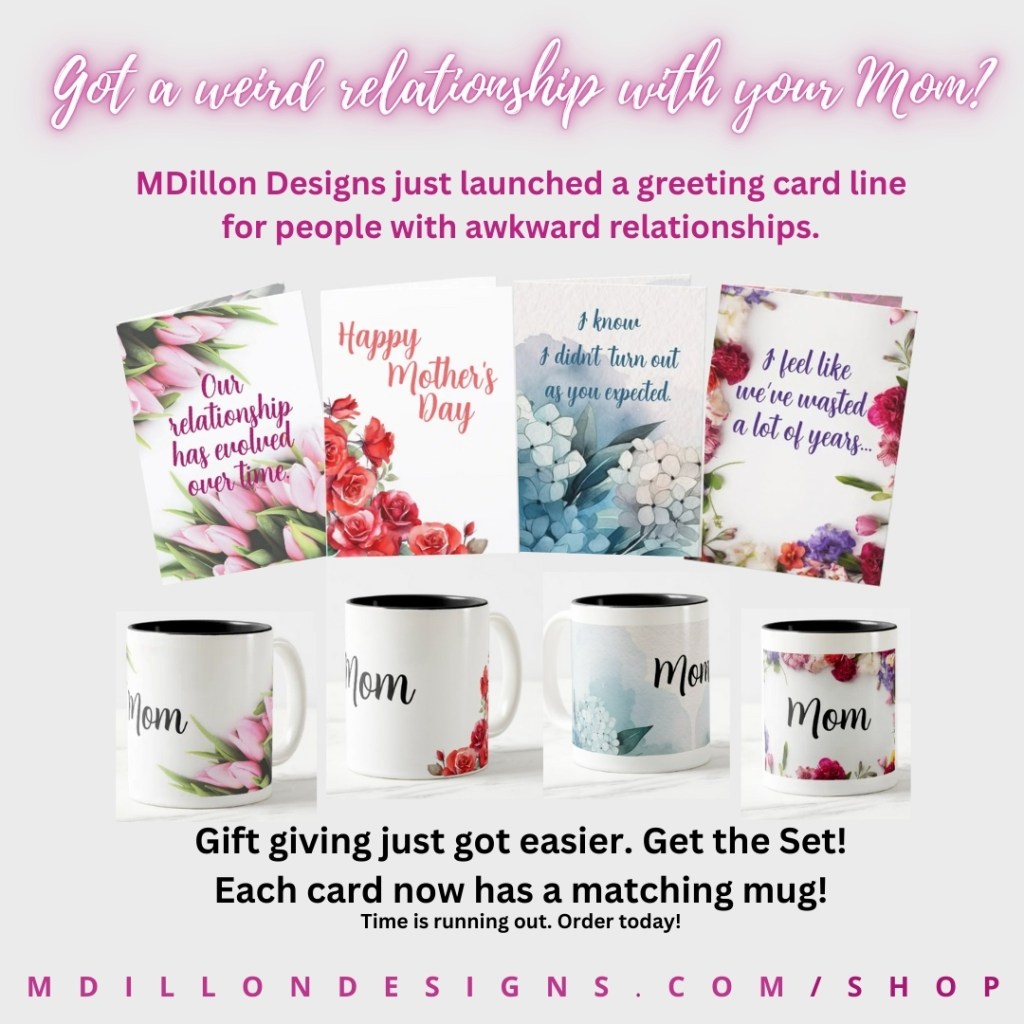
Well, this year, I decided to be a part of the solution. AND I JUST RELEASE MY OWN COLLECTION OF MOTHER’S DAY CARDS!
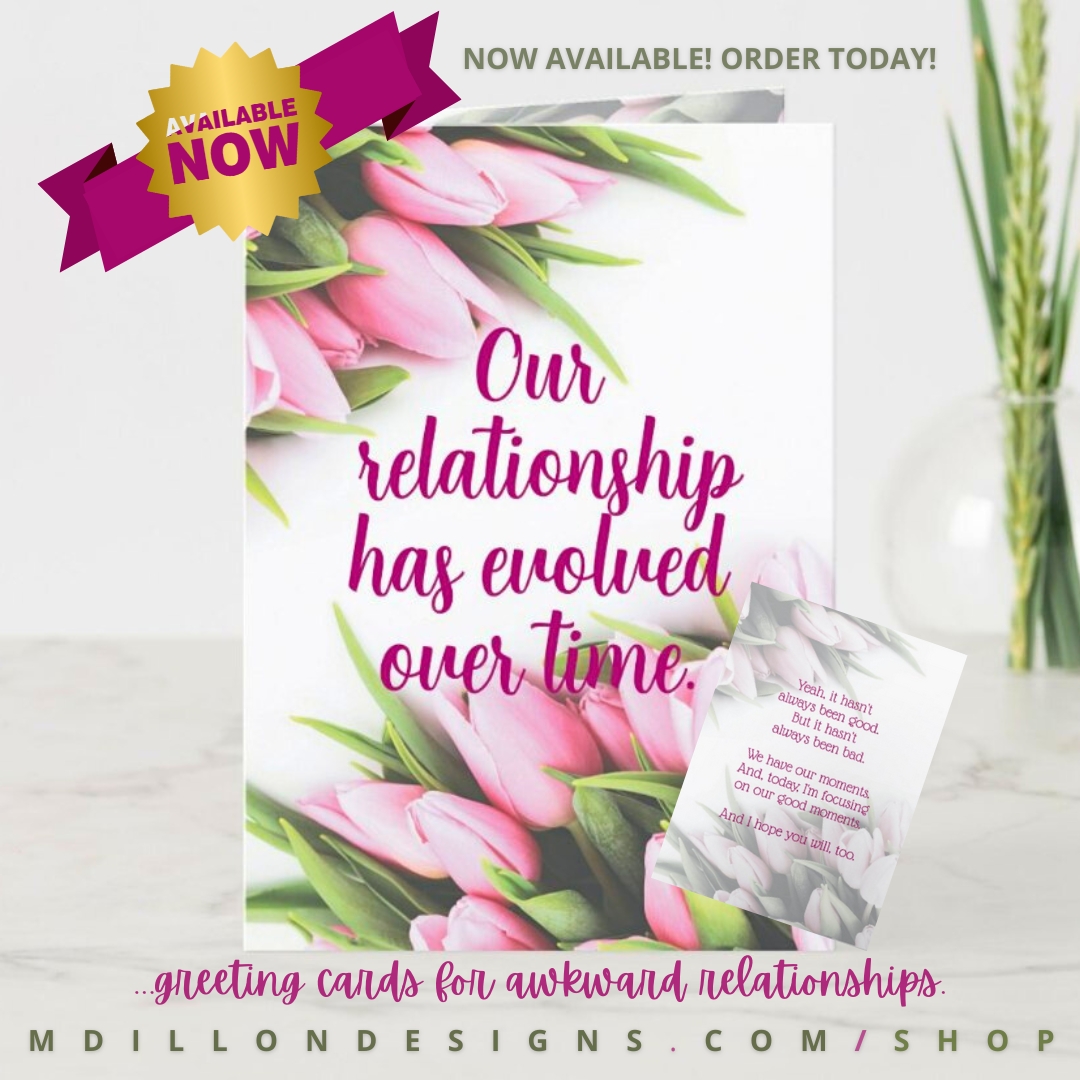
I’m super excited to announce the launch
of my greeting card line for awkward relationships!
I’m starting with a small collection, just 4 Mother’s Day cards that I, of course, designed. From my own experiences, and the experiences of those around me, I wrote heartfel messages that I hope at least one will resonate with you. AND parts of each card can be personalized so that the message is aligned with your truth.
Maybe you say, “Mum,” instead of “Mom,” or maybe “I love you” is a bit strong for your relationship. You get to change things like that. That’s the whole point. We need cards that feel true for us. And I hope these feel more true for you… or someone you love.
Anyway, I’m super excited to share my collection with you! I use a site called Zazzle to handle the printing and shipping, so when you tap the button below it will redirect you to my Zazzle store, where you can order your own personalize Mother’s Day card! So go ahead and check them out. (BTW be sure to check the shipping date to ensure it will arrive in time.)