
I’ve been hearing about the “starving artist” since childhood. As early as third grade, “artists don’t make a dime until they’re dead,” was my canned response when people told me I was talented and should be an artist when I grew up. I’ve known all my life that I didn’t have a chance. And in my environment I wasn’t even seen as an artist; that position was already taken. So I really really didn’t have a chance….
I realize I was conditioned to believe I’d fail if I stepped off the beaten path, but what if the beaten path feels wrong? What if the beaten path is too hard… too uphill for how my brain works and how I’m wired? What if the beaten path is completely opposite to who I am?
But then again, who am I to tell EVERYBODY that I’m going to be the ONE who makes it? Who am I… who’s failed at so much, quit on so much… who struggles with self-confidence… who was always the “runt of the litter” in every circle I found myself in…?
Who am I to say, “I’m going to make it?” Who am I to say, “I get to do it differently?” Who am I to say, “But it’s gonna work for me because THIS IS WHO I AM?”
I don’t fit anywhere else. This is me. I swear I’ve tried to get in line and do what everyone else is doing. I tried. I tried so hard. But this is me. I can’t do anything else. I can’t be anything else. It calls me when I try. It won’t leave me. It’s like a dull ache in my soul that won’t leave me alone. It won’t let me be like everyone else.
I don’t want to be a misfit. I don’t want to stand out. I don’t want to go against what everyone else is doing. But I can’t keep trying to be you. I have to be me. I have to let go of you… of your beliefs about what it takes to succeed… of your criticism of my choice to leave the path, … of your certainty that I will fail.
I have to stop going uphill, and upstream, and accept that some of us are meant to carve our own path. Some of us have to dare to believe… wholeheartedly… that we get to succeed another way.
Trying to be you had me failing. I struggled to be you. It was too hard, too unnatural. Then, I tried to be you while trying to be me. That didn’t work either. It’s like trying to go south and north at the same time.
I’m getting nowhere. I have to let you go. I have to accept that the path MORE traveled is for y’all. And I get to take a different path.
It’s okay for me to follow the guidance in my heart and believe that I’ll get there MY way…. that my route is meant for me, and if I follow it with a concentrated focus, and expectation to succeed, that I will get there. I get to stop feeling guilty for not following your path… the route that most people take. I get to accept that I’m an individual and the call in my soul wouldn’t be so strong in the opposite direction if I was meant to follow you.
I get to believe in myself, MY inner guidance, MY talents, MY skills, MY interests, MY passions, and my path.
Marlene Dillon Empowerment Specialist
The other day, I had this grand revelation. It was linked to my new core belief that “whatever is true replicates itself in nature.” So I looked for examples of provision by Source/the universe. I wanted to know that my expectation and that what I had been taught (that “God provides” for all creatures) is actually true, because I wasn’t seeing it in my life.
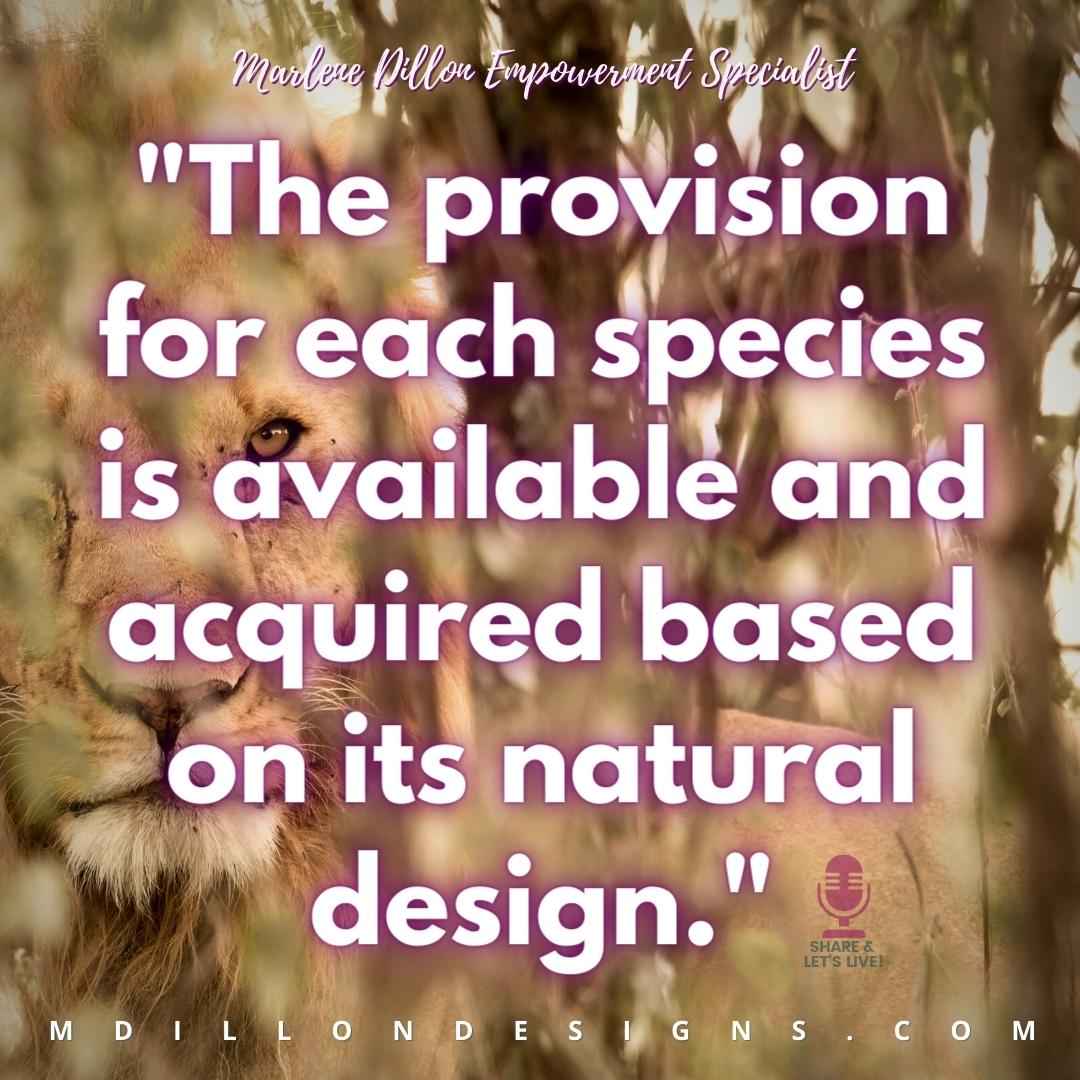
What I realized is that every species has sustenance provided. Some effort is required in attaining it, but the requirements for attaining it are aligned with the natural skills, strengths, abilities, and design of that species. Rarely does a lion just walk up and a zebra is laying there before its den waiting to be eaten. But the lion’s natural capabilities allow it to use its speed, strength, stalking, its teeth, strong paws and jaws to acquire its prey (provision). A bird has its wings, sight, keen hearing, beak and sometimes talons that allow it to seek and grip its prey (provision). The bird doesn’t have to take down a zebra to eat. That’s too hard. That’s not how it’s designed. A lion doesn’t have to fly or dig for worms in order to eat. That’s not how it’s designed. The provision for each species is available and acquired based on its natural design.
This revelation brought me so much comfort, as I realized that my provision is available for me and can be acquired based on my design. According to nature, I don’t need to be anyone else. I don’t need to try to be like another “species” in order to eat. My natural way of being will allow me to acquire what I need to sustain life. I get to eat by being myself.
My natural way of being will allow me to acquire what I need to sustain life. I get to eat by being myself.
Marlene Dillon Empowerment Specialist
So what is my provision… my prey? Ideas. Inspired guidance to create, teach, and share my gifts. Just like a lion stalks its prey, I have to listen and pay attention to the ideas that come to me and I have to remain committed to taking them down.
I have to stick with each viable idea and not let it get away from me. I have to believe that it is my meal, and that if I don’t “kill it,” I won’t eat. I have to stay focused completely on the meal that is in front of me, knowing that my skills, strengths, abilities, and design… my natural way of being… assures me that I’m gonna eat.
My meal is before me. All I have to do is show up as who I am naturally, apply the skills I’ve developed through practice, and hold tightly with complete certainty that this is my provision.
All I have to do is go get it, and I’m guaranteed to eat. According to nature the concept of a starving artist is a lie. The artist only starves as a result of believing that there is no provision for artists. But according to nature every species gets to eat.
It doesn’t matter what other creatures are eating, or how they got their food. All that matters is the meal before us.
And one last thing. As I was journaling, and this revelation was pouring out before me, I asked for an acronym for prey.
P.R.E.Y. stands for:
– Persistence
– Resolve
– Effort
– YOU
Persistence is self-explanatory. Resolve basically means I have to know it’s mine. I’m qualified and capable. I get to have it. Even though some effort is required (often lots), it’s going to be within my capabilities. And the final letter Y is for YOU. YOU have got to own it… in your mind. YOU have got to know it belongs to YOU… that this effort ends in success…. YOU are going to master this prey. YOU have to know that YOU are going to kill it and YOU are going to eat.
There’s no giving up… no letting it get away. If YOU give up, YOU don’t eat. Source… the universe… God provided. YOU have got to wrestle it to the ground, and take it for your meal.
Blessings,
Marlene Dillon Empowerment Specialist
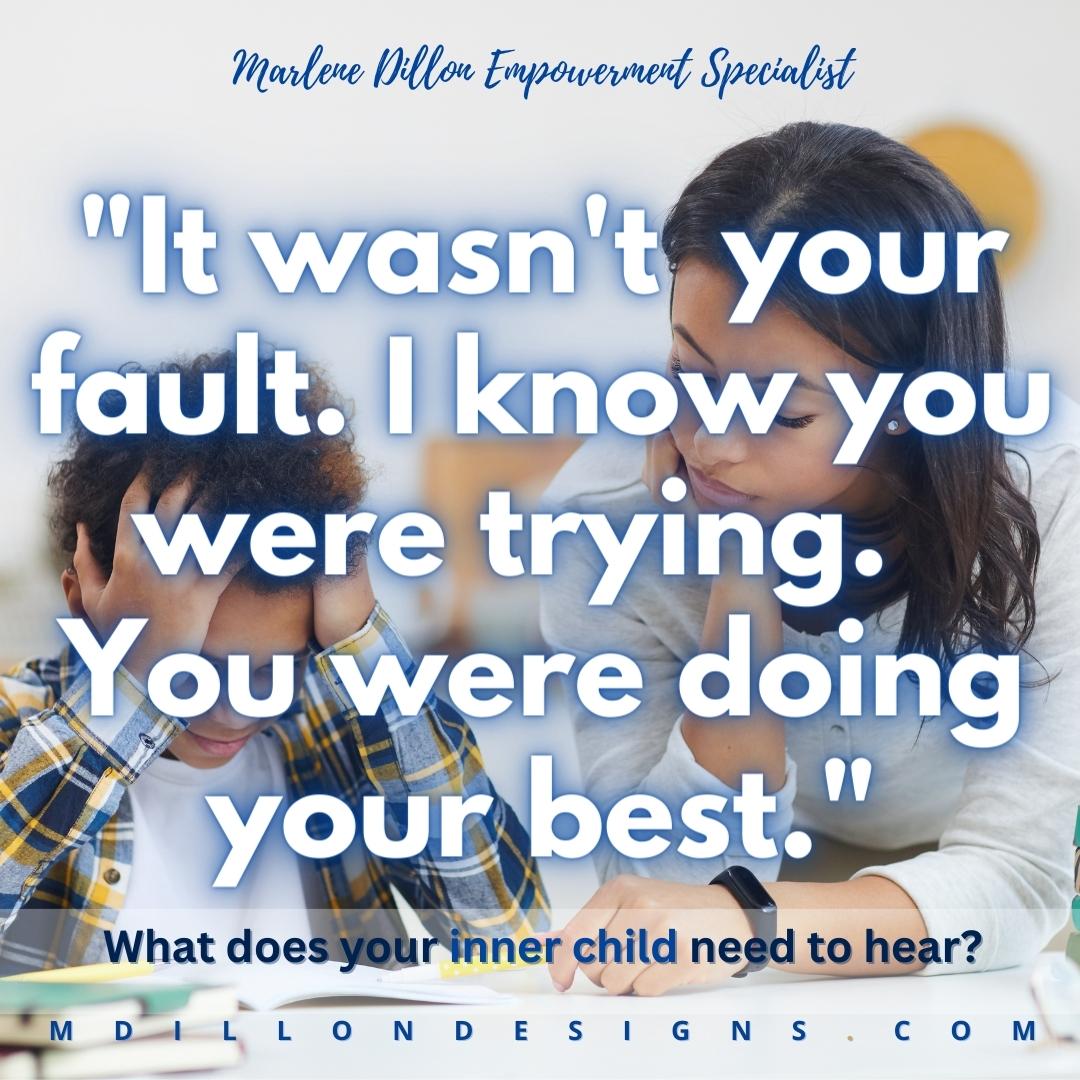
 Yeah, it’s sexist. And it’s unfair. And it leaves you (and a lot of girls, and probably some boys, too) feeling stupid and lazy and unable to do things, or understand things, when all you really needed was someone to see that you needed help, and for them to actually help you…. Remember when Shaun Little’s grandma would come to school, and she’d sit with you and help you understand? She’d take the time to explain the directions and show you what they wanted you to do, and then she’d show you a few more example problems, and soon you could do it by yourself? She really helped you and you appreciated her, and that’s all you really needed…. a kind, patient adult to sit with you and not make you feel bad for not getting it right away. You were smart, you could figure it out. You just needed a little more time and few more examples so your mind could process the rules, and catch on to the patterns….