When someone is being bullied, we tend to only see one character at fault. But all the people who stood around watching, who did nothing, and said nothing, also played a role.
I was just thinking about relationships, particularly familial. In some households, there is an unfortunate dynamic. Both parents are present, and one is abusive (physically, sexually, psychologically, spiritually, emotionally, etc.). Follow me, I’m going somewhere.
For the children raised in this kind of environment, for most of our lives, we retell the story as a fairytale. There is one good fairy and one evil fairy—one good person and one clear villain.
However, as life progresses—especially if we’re committed to inner healing and growth—a moment happens when the very clear dynamic in our minds begins to unravel. As we look back on our stories, our memories, our moments with adult eyes, we begin to see beyond the main characters. We begin to notice the supporting characters. We begin to question the role that others played in the abuse continuing.
“Why didn’t you say something?” “Why didn’t you do something?” “Why didn’t you fight back?” “Why didn’t you leave?” “Why didn’t you try to stop it?” “Why didn’t you listen when I told you this was happening?”
Depending on the answers to those questions, our conditioning toward being empathic to a fault, or even our tendency to make everything our fault (also due to conditioning), we may come to some interesting conclusions.
We may develop compassion for the parent, or we may say, “Yeah, I see what you’re saying, but that’s complete bullsh*t. You should’ve been stronger. You should’ve said something. You should’ve protected me.”
As I was standing by the sink this morning, I recalled a conversation I had online with a friend yesterday on a post about privilege. Don’t leave. I’m going somewhere. This is important.
So a lot of people feel very offended by the concept of privilege. A dominant rebuttal is, “well, I’m white and I didn’t have any special privileges. I was born poor, raised poor, and I worked my whole life. I struggled, too. I pulled myself up by my own bootstraps. That’s just an excuse to blame us for their problems.”
There’s a false assumption that privilege is about money. Privilege is more often about the freedom to go through life without a vast number of considerations and concerns that arise simply because of the color of your skin. It’s a privilege to not have to worry that your name sounds “too Black” when you’re applying for a job, because you’re more likely to have your CV tossed in the trash/placed at the bottom of the stack. It’s a privilege to go to purchase a home, or apply for a loan, knowing that the only considerations are your financial status. It’s a privilege to get on an elevator without seeing fear in someone’s eyes, or someone clutching their purse tight because the media, television, news, and movies all portray Black people as violent thieves and thugs. It’s a privilege to walk down the street without hearing car doors lock for the same reason. It’s a privilege to take a road trip and not have to worry if the gas station or restaurants are safe for people who look like you. It’s a privilege to be able to drive your new car wherever you want without the concern of being pulled over simply because you don’t look like you should be able to afford that car. It’s a privilege to know you would never want to be treated like Black people. And living your daily life without considering the discrepancies in the way we are viewed and treated… that’s a privilege.
The list of examples is waaay longer, but I hope this helps you better understand.
So back to the original topic…
In some abusive familial environments, there is one clear abuser and the other is seen as a victim or an innocent bystander. This morning, as I was standing at that sink, I started thinking about my upbringing that was more of the “good cop, bad cop” dynamic. For most of my life, I saw my “good” parent as the clear saint. I never considered their role in my negative experiences. I convinced myself that they were not present and had no idea. However, as I began to learn about them and things they’ve shared with others about me, and even things they said to me directly, something clicked. I remembered that in the game of “good cop, bad cop,” both cops are on the same side.
I began to look back at my life and see the less than saintly moments. I began to notice how they ignored what was happening and didn’t get involved. I noticed how they smoothed things over afterward, but that while it was happening they were silent. I began dismantling the concept of saint. I saw that they were actually complicit.
I accepted that in order for them to say nothing and do nothing, that either they agreed with what was happening, or they cared more about what they gained (or avoided) by staying silent. They knew what I was going through, and they chose not to get involved. They had that luxury, because they weren’t directly affected.
As I look back on my life—and the scars left from what I experienced—my memories are evolving. I’m recalling the parts of the story I ignored. I see that “good” parent was actually in the room, or within earshot. I see that they could have stopped it, they could have said something, but they chose their peace or their fear and let me suffer. I see that they were both adults, that they were equals in authority, and if they had interrupted, interjected, reasoned, or just did something, my whole life experience could have been different.
When I look at the way Black people are treated in our society, one would think people just don’t know because they’re not living it. But when asked, “Who would want to be treated like Black people?” no hands raise…. whether they ask children or adults. That tells me that people are aware, but they aren’t saying anything. They are seeing the discrepancies and choosing not to get involved. And I believe that happens for one of two main reasons, either they agree with what’s happening, or they care more about what they gain (or avoid) by staying silent.
You’d be surprised at the power of one voice. My dear friend uses her social media to advocate for marginalized communities. As she studies these topics for herself, she educates her Facebook friends and family about what she’s learned. Simple steps like that create a ripple. She’s helping people think about things that they have the privilege to not think about. She is helping people who have spent most of their lives believing what they heard about Black people, gay people, transgender people etc. to learn the actual facts, rather than rumors. She is doing her part to support other humans to experience our rights to “life, liberty, and the pursuit of happiness.”
If she reaches one person, and that causes them to share this new perspective with their friends and loved ones, eventually that ripple extends to other families, then other communities, and other cities, states, and even nations.
Tough truth….
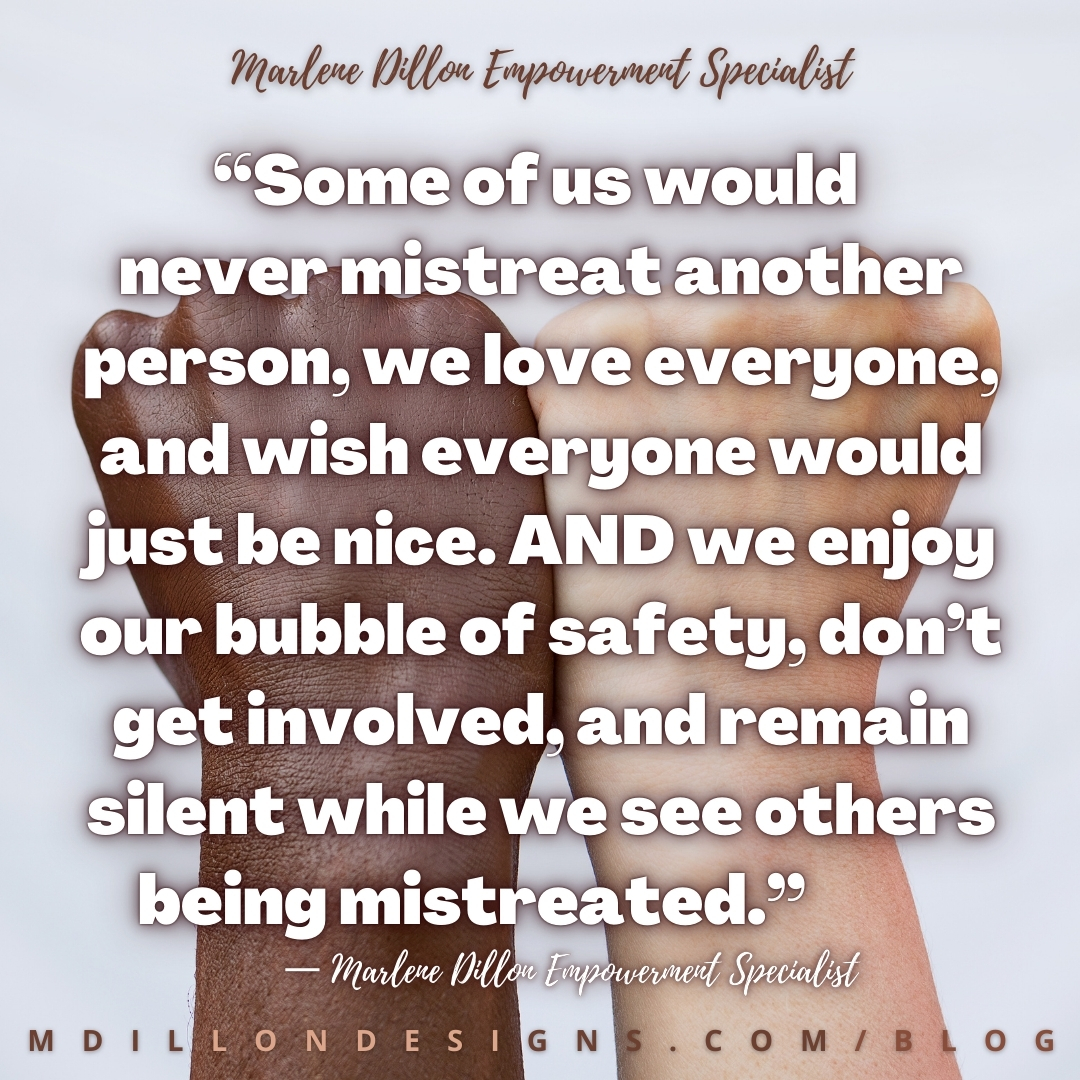
Some of us would never harm another human, but we may know someone is being mistreated and choose not to get involved. Our voice could possibly make a difference, but we choose to remain silent.
In that instance, we may not be the bully, but—if our silence is helping the abuse continue—we’re at least bully adjacent.
I’ve never been one to speak out unless things directly affected me. I enjoy my peace and hate conflict. However, because of love, I cannot be silent and watch people I care about being mistreated and seen as enemies. I do not like politics, AND I cannot sit quietly when I see that the upcoming election is so much bigger than choosing between two parties. I can’t see something and not say anything. I can’t just act like this is a usual election, when so much is at stake. So, even though I hate to get involved, I’m sharing information. And it’s tempting to not do it, because I don’t want anyone to come on my posts with hateful comments or wanting to debate. But I’ve chosen that it matters more to me to say something.
One person’s voice can be very powerful. Sometimes one person speaking up, causes others to join in to support. Sometimes that’s all it takes to stop a bully.
One person’s silence is powerful, too. It gives more power to those abusing authority and it ensures that whatever has been going on will continue. Things can change, but not if those who can say something remain silent.
We only remain silent for two reasons: either we agree with what’s happening, or we care more about what we gain (or avoid) by staying silent.
I don’t agree with what’s happening, so I choose to use my voice. I don’t agree with the bullies. So I refuse to be bully adjacent.
What about you?
Blessings,
Marlene Dillon Empowerment Specialist
*** Learn more about me, Marlene Dillon Empowerment Specialist! ***
 MDillon Designs & Publishing